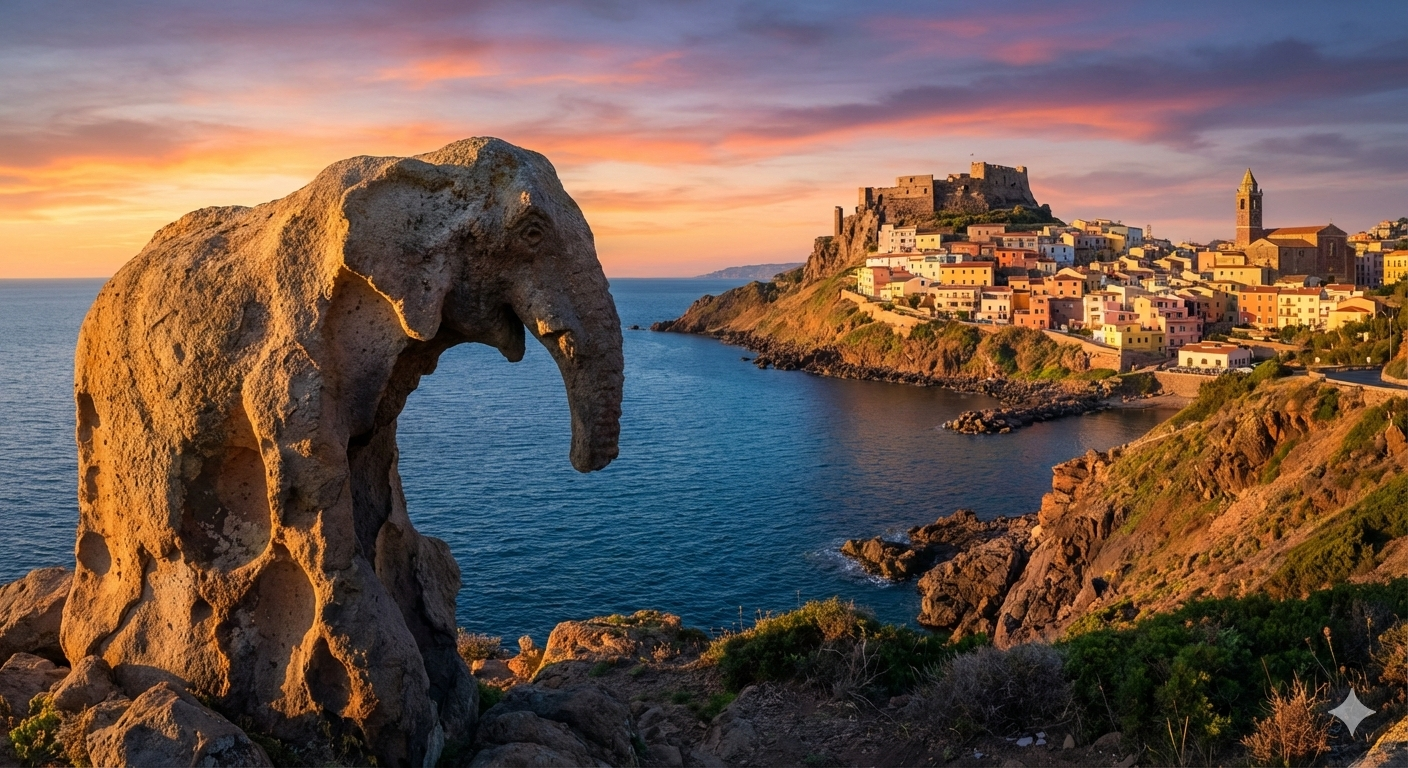
It is one of the most beautiful villages in Italy. But it can become a trap if you don't know how to get around.
Castelsardo is a living postcard: a fortified village perched over the sea facing Corsica. It is a must-see for those staying at Villa Malvasio (just 30 minutes away from us), but it should be approached wisely to avoid turning the trip into a stressful queue under the sun.
Here is our tried-and-tested itinerary to enjoy the history without the hassle.
1. The must-see stop: The Elephant Rock
Even before reaching the town, along state road 134, you will come across a natural sculpture that looks like it came out of a fantasy film. The Elephant Rock is a trachyte boulder eroded by the wind that has taken on the perfect shape of a seated pachyderm.
Insider Tip: Don't just take a photo from the road! Park carefully and walk up to it. You'll notice that inside the rock there are Domus de Janas (prehistoric tombs) carved out thousands of years ago. It's an archaeological monument, not just a geological one.
2. The "Anti-Traffic" Strategy (Essential!)
The old village is perched on a promontory and the streets are narrow. In summer, trying to drive up to the main square (Piazza Nuova) is risky: traffic is often blocked and you can get stuck with no way out. Beware of the Port: Many tourists make the mistake of leaving their car at the Tourist Port, not knowing it's almost 2km from the center! Avoid it if you don't want a long uphill walk under the sun.
The right move: Look for parking along the main road (Via Roma and side streets) in the lower part of the town, or use the well-marked paid parking areas (blue lines) at the foot of the climb. Once you've left your car here, you're in the strategic spot: you can walk up to the Castle (an uphill walk but doable) or wait for the urban shuttle that connects the main road with the entrance to the historic center.
3. The conquest of the Castle (On foot)
Once you reach the entrance to the village, the real magic begins. Castelsardo should be explored on foot. Enter through the gates in the walls and lose yourself in the narrow alleys (the "carruggi").
What to look for: Don't just look at the sea, look at the house doors. You'll often see local women sitting outside weaving the famous Castelsardo Baskets. It's an ancient art passed down from mother to daughter. If you want an authentic souvenir, buy it directly from their hands.
4. The Doria Castle and the breathtaking view
At the top you'll find the Castle (open to visitors, home to the Weaving Museum) and panoramic terraces. From here, and from the nearby Cathedral of Sant'Antonio Abate (famous for its bell tower overhanging the sea and covered in colorful majolica tiles), you can see the entire Gulf of Asinara. On clear days, Corsica seems close enough to touch.
5. Where to eat (without traps)
Castelsardo is full of tourist restaurants with "Fixed Menus". Be wary of those who insistently invite you in from the street. If you want truly fresh fish, look for the more secluded restaurants in the upper alleys or those frequented by locals. Or, ask us for advice before you go: we'll book you a table where the lobster is local, not imported.
Conclusion: The perfect moment The best time to go up to Castelsardo? Late afternoon. The heat eases, the sunset light sets the rocks and bell tower ablaze, and most of the tourist groups by coach are leaving. You'll have the village (almost) all to yourself for an unforgettable aperitif.
After the climb to the Castle, there's nothing better than returning to your Suite with private Jacuzzi (https://www.villamalvasio.com/camere) to relax your muscles.